Few things hurt more as a parent than knowing someone is hurting your child.
Maybe your teen has told you what’s happening. Maybe they came home upset after school. Or maybe they haven’t said much at all, but you can tell something has changed.
They don’t want to go to school. A friendship has suddenly fallen apart. They seem anxious when their phone lights up. They’re quieter than usual, more irritable, or spending more time alone.
You know your child, and something doesn’t feel right.
If bullying is the reason, you may be wondering how serious it is, what you should do, and most of all, how you can make it stop.
The first thing your teen needs is to know that you believe them and that they don’t have to handle this alone. From there, you can begin figuring out what’s happening, whether they feel safe, and what needs to happen next.
How Common Is Bullying Among Teens?
Bullying remains a significant problem for teens across the country.
In the CDC’s 2023 national survey, 19% of U.S. high school students reported being bullied on school property during the previous year. Federal education data also found that about 19% of students ages 12–18 experienced bullying at school in 2021–22, and among those students, 22% said at least some of it happened online or through text messages.
But statistics don’t really capture what bullying looks like inside a family.
It can look like your teenager worrying about where they’re going to sit at lunch. It can be the stomachache that shows up every Sunday night. It can be watching a child who used to enjoy school start looking for reasons to stay home.
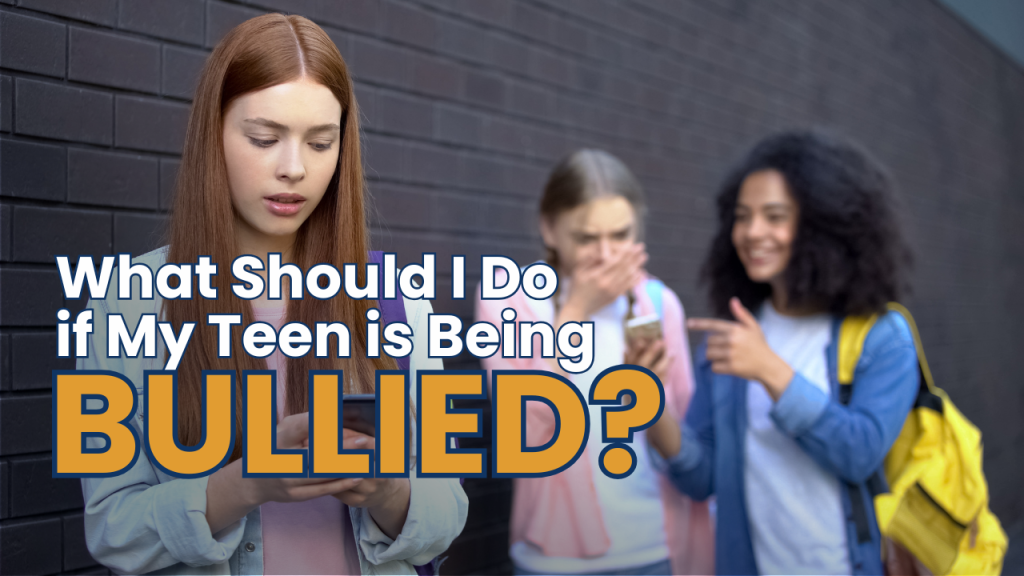
And increasingly, bullying doesn’t end when the school day does. Group chats, social media, texts, gaming platforms, and shared photos can follow a teenager home.
That’s one reason it’s so important for parents to notice changes, even when their teen isn’t ready to explain them.
What Is Bullying?
Teenagers can be unkind to one another. Friendships change. Arguments happen. Hurt feelings happen.
Bullying is different.
Bullying involves aggressive behavior where there is a real or perceived imbalance of power, and the behavior is repeated or has the potential to happen again.
That imbalance of power isn’t always physical. It can come from popularity, social influence, a group targeting one person, access to embarrassing information, or the ability to humiliate someone online.
Bullying can take several forms:
- Verbal bullying: insults, threats, teasing, or name-calling
- Social bullying: rumors, humiliation, exclusion, or turning other people against someone
- Physical bullying: hitting, pushing, threatening, or damaging belongings
- Cyberbullying: harmful or humiliating behavior through texts, social media, gaming platforms, group chats, or other digital spaces
House of Hope has long encouraged parents to take all of these forms seriously, not just physical bullying.
How Can I Tell If My Teen Is Being Bullied?
Sometimes a teen will tell you directly. Other times, you may notice the change before you understand the reason.
You might see:
- A sudden reluctance to go to school
- Changes in friendships
- Frequent headaches or stomachaches
- Falling grades or loss of interest in school
- Changes in eating or sleeping
- Irritability, sadness, anxiety, or withdrawal
- Lost or damaged belongings
- A noticeable change in how they react to their phone or social media
- Giving up activities they once enjoyed
- A drop in confidence
None of these automatically means your child is being bullied. But when several changes begin happening together, it’s worth checking in.
Pay attention, too, if your teen starts telling you about “a friend” who is being bullied. Sometimes a young person will talk about someone else’s experience before they’re ready to admit that it’s happening to them.
What Should I Say When My Teen Tells Me They’re Being Bullied?
If your teen tells you they’re being bullied, your first instinct may be to fix it immediately.
You may want to call the school, confront the other parents, or start asking a hundred questions.
Try to resist that for a moment.
Your child has probably been working up the courage to tell you. Give them room to talk.
You might say:
“I’m really glad you told me.”
“I’m sorry this is happening.”
“You didn’t do anything to deserve this.”
“We’ll figure out what to do together.”
Then listen.
You can ask what happened, how long it has been going on, what they’re most worried about, and whether they feel safe.
It’s also helpful to include your teen in deciding what happens next whenever possible. Teens can be afraid that involving adults will make things worse or that they’ll lose control of the situation altogether. At House of Hope, our licensed counselors encourage parents to listen to what their teens think might help rather than assuming there is one simple solution.
What Can Parents Do to Help Stop Bullying?
There isn’t one answer that works for every situation.
For some families, a conversation with a teacher or counselor may be enough to get things moving in the right direction. In other cases, parents may need to document what is happening, meet with school administrators, ask for a safety plan, report cyberbullying, or escalate the issue within the district.
Sometimes a change in schedule, class, bus, lunch period, activity, or friend group can help.
And sometimes the larger environment itself needs to change.
That may mean considering another public school, a charter school, private or Christian school, an online school, homeschooling, or a combination of options.
Parents are often hesitant to consider changing schools because it can feel as if they’re letting the bully win.The goal isn’t to prove that your child can endure a harmful environment. The goal is to help them feel safe, healthy, connected, and able to learn.
In serious situations, transferring to another school may be the best solution.
Changing schools won’t be right for every child. But parents should know it is an option, especially when bullying continues despite repeated attempts to address it.
Should I Make My Teen Stay and Work Through It?
This can be one of the hardest decisions for parents.
We want our children to become resilient. We want them to learn that difficult situations don’t always require walking away.
At the same time, resilience does not mean learning to tolerate ongoing harm.
There are situations where a teen can remain at school, work with supportive adults, develop confidence, and come through the experience stronger. There are also situations where staying is taking a real toll on their emotional health, ability to learn, or sense of safety.
Instead of asking whether leaving means your child is giving up, it may help to ask:
Is this still a healthy place for my child to learn and grow?
If the answer continues to be no, it may be time to look more seriously at other options.
What Does a Christian Response to Bullying Look Like?
Christian parents sometimes struggle with this because we teach our children to forgive, show grace, love others, and pray for people who hurt them.
Those things matter.
But forgiveness does not require your child to remain in a situation where someone continues to mistreat them.
House of Hope’s teaching on bullying has always made room for both grace and boundaries. Every person is made in God’s image and worthy of dignity but loving someone does not mean allowing harmful behavior to continue unchecked.
Your teen can forgive someone and still keep their distance. They can pray for someone and still report what is happening. They can show grace and still say, “You may not treat me this way.”
And if a change of environment becomes necessary, they can leave without believing they have failed.
One of the most important things you can do is remind your teen that the person hurting them does not get to decide who they are.
They are fearfully and wonderfully made.
They are loved by God.
They have value and purpose that no rumor, insult, rejection, post, group chat, or act of cruelty can take away.
What If the Bullying Doesn’t Stop?
If you have talked with the school, followed the recommended steps, and your child is still being bullied, don’t assume you’ve reached the end of your options.
You may be able to escalate the issue within the school or district. You may decide that counseling would help your teen work through what they’ve experienced. You may want to consider a different school or learning environment.
Families today have more educational choices than many parents realize, including public-school transfers, charter schools, private or Christian schools, online programs, homeschooling, homeschool co-ops, and hybrid approaches.
Homeschooling, in particular, can feel intimidating if you’ve never considered it. It doesn’t necessarily mean a parent has to teach every subject personally or recreate a traditional classroom at the kitchen table. Online classes, prepared curricula, tutors, co-ops, outside instructors, and community programs can all be part of the picture.
The right choice will look different for every family.
What matters is knowing that you have choices and that you don’t have to keep your child in an environment that is continuing to harm them simply because you’re afraid of making a change.
A Practical Guide for Parents
When you’re in the middle of something like this, it can be difficult to sort through all of your options at once.
That’s why we created the My Teen Is Being Bullied: Parent Action Guide.
It walks parents through the practical side of what comes next, including:
- What to do when your child first tells you
- Questions to ask
- What to document
- What to ask the school
- How to handle cyberbullying
- When and how to escalate the issue
- How to tell whether the school’s plan is working
- When it may be time to consider another school
- Public, private, Christian, online, homeschool, and hybrid options
- Ways to help your teen rebuild confidence
- How faith, forgiveness, and healthy boundaries can work together
One Last Thing
If your child is being bullied, you may be angry, frightened, or heartbroken.
You may also be second-guessing yourself.
How did I not know?
Should I have noticed sooner?
What if I make the wrong decision now?
Your child doesn’t need you to have handled every moment perfectly.
They need to know you’re there now.
Listen to them. Stay close. Pay attention to what changes. Ask God for wisdom, and don’t be afraid to advocate for the child He entrusted to you.
Sometimes courage means helping our children stand their ground.
Sometimes wisdom means helping them find a new place to stand.
Either way, bullying does not get to write the rest of their story.
“The Lord is close to the brokenhearted.” — Psalm 34:18
And remember, hope changes everything.