
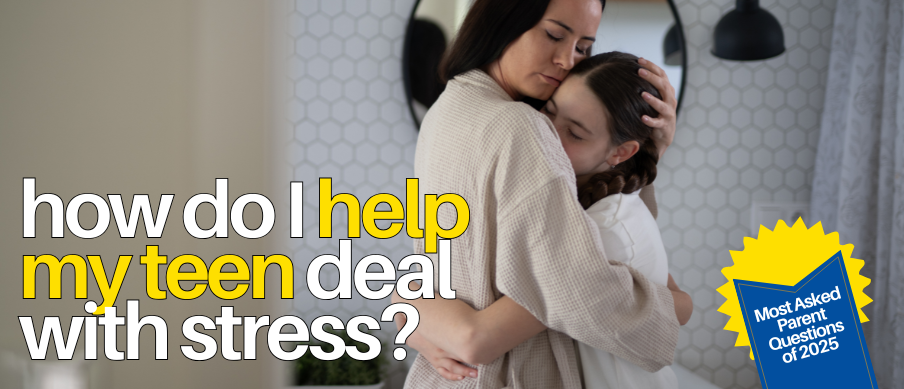
Over the past year, parents of teens across the country have been asking the same questions—so often that they rose to the top five most Googled questions in 2025. Each one comes from the same place: a deep desire to understand what their teens are experiencing and how to support them through a difficult season.
How do I help my teen deal with stress? is one of the most common.
Perhaps you’ve asked that question yourself—wondering if what you’re seeing is normal, if stress could be playing a role, or if there’s something more you should be doing.
That’s why House of Hope is answering the most Googled questions parents of teens are asking—so you don’t have to sort through fear, conflicting advice, or worst-case scenarios on your own. Our hope is to offer clarity, reassurance, and a path forward grounded in understanding, faith, and compassion—so you can feel more confident, less alone, and better equipped to support your teen.
If you’ve been noticing more stomachaches, headaches, or exhaustion in your teen, you may be quietly wondering what’s really going on.
You might have found yourself asking:
Is my teen burned out?
Why does my teen’s stomach hurt so often?
Why does my teen keep getting headaches?
If so, you’re not alone. And you’re not overreacting.
Many parents are seeing these same signs and wondering where everyday stress ends and something more serious begins. What makes this season especially challenging is that teens don’t always have the words to explain what they’re feeling. Instead of coming out in conversation, stress often shows up in their bodies.
When Stress Doesn’t Sound Like Stress
Adults tend to name stress out loud. Teens usually don’t.
Rather than saying, “I’m overwhelmed,” a teen may complain about headaches. Instead of sharing anxiety, they may talk about stomach pain or feeling tired all the time. These physical symptoms are often the body’s way of expressing what the heart hasn’t yet learned how to articulate.
Stress, pressure, and emotional overload don’t stay contained in the mind. They affect the whole person.
Is My Teen Burned Out?
Burnout isn’t just something adults experience at work. Teens can burn out too—especially when they feel pressure to keep up academically, socially, or emotionally without enough space to rest.
A burned-out teen may:
- Feel exhausted even after sleeping
- Seem irritable, withdrawn, or emotionally flat
- Lose interest in things they once enjoyed
- Struggle to concentrate
- Experience frequent physical complaints with no clear medical explanation
This isn’t laziness or defiance. It’s often a sign your teen has been trying very hard for a very long time.
Why Does My Teen’s Stomach Hurt?
The gut and the brain are deeply connected. When stress builds up, the digestive system often feels it first.
For many teens, emotional stress can show up as stomachaches, nausea, or changes in appetite. These symptoms are real. They are not imagined or exaggerated. Even when tests come back normal, the discomfort your teen feels is valid.
Sometimes the body is simply expressing what your teen doesn’t yet have words for.
At the same time, it’s important not to assume stress is the only factor. If physical symptoms persist, worsen, or interfere with daily life, it’s always wise to consult a medical professional to rule out any underlying physical conditions. Seeking medical care doesn’t mean you’re overreacting—it means you’re caring well for your teen.
Both physical and emotional health matter, and paying attention to each is an important part of supporting your child.
Wondering if your teen needs counseling? Take this short quiz.
Concerned your teen may need more support? Read our parent guide here.
Why Does My Teen Get Headaches?
Headaches are very common in teens and typically result from several overlapping factors—not a single cause.
They are often the body’s way of signaling that something is out of balance, physically, emotionally, or both.
Common contributors include:
Stress and emotional overload
Academic pressure, friendships, expectations, and constant stimulation can cause muscle tension in the neck, shoulders, and jaw—often leading to tension headaches or migraines
Lack of sleep
Teens need more sleep than adults, yet many get far less than their bodies require. Sleep disruption is a major headache trigger.
Dehydration
Even mild dehydration can cause headaches, especially for active teens.
Screen time and eye strain
Long hours on phones, tablets, and computers can contribute to eye strain, neck tension, and worsening headaches throughout the day.
Hormonal changes
Hormonal fluctuations—especially in teen girls—can play a role in headaches and migraines.
Anxiety and suppressed emotions
When emotions are held in rather than processed, the body may respond physically. This does not mean the pain is imagined—it means the body is carrying what the heart hasn’t yet released.
Medical causes that should be ruled out
Headaches may also be related to vision issues, sinus problems, migraines, nutritional deficiencies, or other medical conditions. If headaches are frequent, severe, worsening, or disruptive, a medical evaluation is important.
What Parents Can Do (Without Trying to Fix Everything)
When your teen is struggling, it’s natural to want answers—and fast solutions. But often, what helps most is simpler and gentler than we expect.
Support can begin with:
- Slowing the pace where possible
- Listening without rushing to solve
- Naming what you notice with kindness (“You seem really worn down lately”)
- Making room for real rest—not just catching up
- Seeking support when stress feels bigger than what your family can carry alone
You don’t need perfect words. Presence matters more than advice. And prayer matters too—God promises to smooth the rough places and make the crooked places straight (Isaiah 40:4).
A Hopeful Word for Parents
At House of Hope, we believe God cares about every part of your teen—their body, mind, and heart. While the internet can offer information, our true help comes from Him. He knows your teen better than anyone else and He wants to help them live a victorious life.
Scripture reminds us that weariness is not something to hide from God—and your teen needs that reminder, too.
“Come to me, all of you who are weary and carry heavy burdens, and I will give you rest.” (Matthew 11:28)
If your teen’s stress feels persistent or confusing, remember this: noticing is not failure—it’s love. You are paying attention. You are asking questions. And that matters more than you may realize.
Support doesn’t mean something has gone wrong. It means you’re choosing not to walk this road alone. You are exactly who your teen needs—even if they don’t always show it.
We’re praying and believing with you for victory over stress!